
Culture · Bosra
Bosra: a theatre inside a citadel
Sit in Bosra's Roman theatre, the only one in the world with its upper gallery still intact, and explore the Nabatean, Roman, Byzantine and Umayyad layers of the old city.
- One to two hours
- Duration
- Early morning or late afternoon
- Best time
- Ask for a price
- About cost
The experience
About the experience
Ancient City of Bosra (Tell el-Amarna tablets 14th c. BC; northern capital of the Nabatean kingdom until annexed by Rome in 106 AD) became capital of the Roman province of Arabia — UNESCO Site 22 inscribed 1980, on the Danger List since 2013 with Syria's six World Heritage sites. Criteria i, iii, vi: the 2nd-c. theatre (probably under Trajan) is the only Roman theatre of its type with its upper gallery in the form of a covered portico completely preserved; the 6th-c. basilica of Sergios, Bacchos & Leontios/called Bosra Cathedral is a landmark in early centrally-planned church architecture; Al-Omari Mosque is among the oldest surviving mosques (1st c. Hegira, restored 1950) and Madrasa Mabrak al-Naqa among Islam's oldest celebrated madrasas.
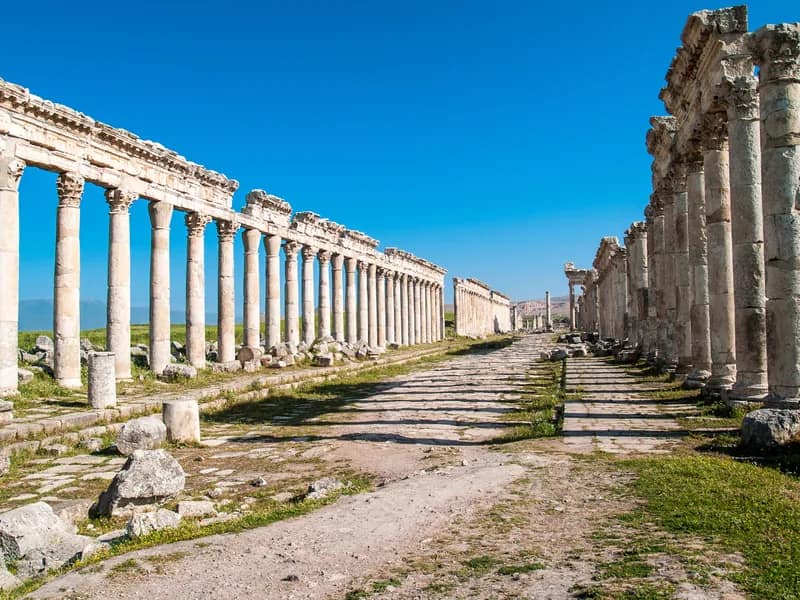
Built of Hauran's dark volcanic basalt for up to 15,000 spectators, the theatre was fortified between 481 and 1251 into a citadel guarding the road to Damascus — its cavea survives near-perfect because walls and towers were built into and around it. Around it sprawls the archaeological park: colonnaded streets, Nabatean and Roman monuments, Christian churches, mosques and madrasas of a city that once held 80,000 inhabitants and served as the key caravan stop to Mecca. The black basalt gives the whole ensemble its brooding cohesion.
The open basalt site is protected under Antiquities Law 222 (1999) with DGAM master plan and 2007 Protection Committee; a modern village grown among the ruins is being resettled outside the 116.2 ha property (buffer 200.4 ha, boundary modified 2017). Visit in early morning or late afternoon — the stone stores heat fiercely. Check locally for access as conservation continues.
Practical tips
- 1
Climb the theatre's tiers to appreciate its scale and the acoustic effect that still works today.
- 2
In summer, visit in the early morning or late afternoon — the black basalt stores heat intensely.
- 3
Allow one to two hours for the theatre and the surrounding archaeological park.
- 4
Wear a hat and carry water; shade is scarce across the open site.
- 5
Conditions change: ask your hotel or our team in Damascus for the latest on access before you go.
More to do in Bosra
More to do nearby
Destinations
Ready to explore Bosra?
Request a hotel quote for Bosra and plan your trip with our local team.